Showing posts with label 1812. Show all posts

Friday, November 29, 2024

199, 200. Claudia J. Gilmour Johnson and M. Gilmour

We are reaching the milestone of the 200th name on the list (more or less, considering--some of the students may be listed with two different names, because of handwriting or name variations).  The roster of Mordecai students I compiled in 1996 has two named Gilmour: Claudia Gilmour of Halifax County, North Carolina, who was at the school in its first session 1809, and then again from second session 1810 to second session 1813; with William Gilmour as the adult name on the account; and M. Gilmour, who was only there in 1809.

Even in 1996, I knew enough about Claudia J. Gilmour Johnson to give her a paragraph in the "Brief Biographical Sketches" appendix of my dissertation. She married Haywood Johnson in 1819 at Petersburg, Virginia; Rachel Mordecai apparently suspected that the match was against their family's wishes. They lived on a farm outside Warrenton, and were friends with Caroline Mordecai Plunkett there in the 1820s. They had a son, Arthur Gloster Johnson. Like a lot of other Warrentonians and Mordecai alumnae, she moved to La Grange, Tennessee, with her family, and helped run a girls' school there. She died by 1835.

So, that's a pretty good start! Let's see what we can find online now.

Eh, not that much, really. I thought her somewhat unusual first name and all the geographic details would help, but "Johnson" is a tough last name to work with. Claudia Gilmour may have continued as a student at Raleigh Academy after leaving Warrenton; a student with that name excelled in drawing and music at the Raleigh Academy examinations in November 1815.

But as for her birthdate? Grave site? Parents? I'm coming up blank. And that "M. Gilmour" might be a sibling, but without the rest of Claudia's picture, it's hard to say. Maybe you know more about these 19c. "Gilmour Girls", blog reader?

Thursday, August 29, 2024

195. Hannah Gibson

 There is a student named Hannah Gibson in the student rolls of the Mordecai school, which I assembled for my 1996 dissertation. She was at the school from mid-1812 to the end of 1813, so three sessions. I don't have a hometown, a parent name, or any other details in that appendix. So I'm not sure what we'll be able to find now, almost 30 years later, but let's have a look around anyway....

Well, here's one candidate who fits the part: a Hannah Gibson from North Carolina, born in 1800,  daughter of Thomas Gibson (b. 1763). She first married in 1819, to George Crothers (or Cruthers) in Randolph County NC. She married again in 1831, to a divorced man named Pierce M. Nixon Jr., also in Randolph County. They were still living together in Randolph County for the 1850 federal census, along with a neighbor's child, George N. Allred.

So, she's the right age and place for a Mordecai student; still, no "gotcha, aha!" connections so far. And her first and last name aren't distinctive enough, in isolation, to say this is the one. But it's the best possibility I saw.

Friday, May 31, 2024

191, 192. Clara and Rosa Garnier

There are two Mordecai students named Garnier in the appendix of my dissertation. Clara and Rosa Garnier may have been from Wilmington, North Carolina; they both seem to have attended from early 1811 to late 1813, and John Garnier is the adult name attached to their account.

Well here's a first: I think Clara Garnier might be the first Mordecai student (that I know of) who was born outside of the United States.  Clara Louise Garnier (c1800-1867) was born in Bordeaux, France (according to her tombstone), and emigrated with her father John Garnier and mother Ann Rosalia Boutet to the United States, settling in Wilmington by 1805. Her mother died in 1810 (which might explain why both girls arrived at the Mordecai school in the beginning of 1811). She married in 1822, to businessman George W. Barkley. They lived in Pensacola, Florida, and had nine children born between 1823 and 1838. Here's a photo of her daughter and namesake, Clara Garnier Barkley Dorr (1825-1899). Clara's granddaughter, Martha Sawyer Gielow, was a writer and public speaker, founder and director of the Southern Industrial Association.

Rosa B. Garnier (c1804-1842) was Clara's younger sister. She married Dr. John O. Smith, and died in 1842, at age 38.

The Barkley House, where Clara Garnier Barkley lived, still stands in Pensacola.


Wednesday, December 7, 2016

163, 164. Eliza and Harriet Field (and maybe 165. Another Eliza Field?)

Two students named Field are in the rolls of the Mordecai school, both from Mecklenburg, Virginia, both among the first students when the school opened in 1809. Eliza Field and Harriet Field were both at the school for six sessions, on and off between 1809 and 1813 for Harriet, 1814 for Eliza.

These might be Harriet and Eliza Field, the daughters of judge Hume Riggs Field (1772-1831) and his first wife Millicine (or Mildred) Young Field (1782-1827), of Mecklenburg Virginia.  The dates might not work out, though: Harriet H. Field was born in 1800--so she was nine the year the school opened, that makes sense. Eliza, however, was younger--born in 1806--maybe too much younger to be a Mordecai student in 1809.

If Harriet's sister Eliza was the Eliza Field at the Mordecai school in 1809, she would have been three years old, and the youngest known student. So I suspect she was the Eliza who attended after 1812; but a different Eliza Field, maybe a cousin, might have been there in 1809 and early 1810. The name isn't so unusual, anyway. Assuming the daughters of Hume and Millicine Field attended the Mordecai school...

Harriet H. Field (1800-1850) married Charles Perkins in about 1821, and they had at least one child, Marietta. She was widowed around 1828, and died in Tennessee in 1850, aged 50 years.

Eliza Mildred Field (1806-?) married Charles Perkins' brother, Constantine Perkins (1792-1836) in about 1824, and they had at least three children, Constantine, Ann Eliza, and Virginia in Tuscaloosa, Alabama. Her husband served in the Alabama legislature, and as the state's attorney general.

Thursday, March 10, 2016

159 and 160. Susanna (Suky) and Wilmouth Fawn

This month's entry brings us a hard truth about schools in the Early Republic. Even among the most privileged classes, child mortality was a fact of life, and running a school sometimes meant facing a student's death.

There are two students with the surname Fawn in my rolls of the Mordecai school. Suky Fawn (or "Sucky", as I have it transcribed) and Wilmot Fawn. Both were enrolled for only one session (the second half of 1812), and both have a Captain Fawn as the adult name on the account. Suky Fawn died at the school in August 1812.

We'll get to Suky in a minute, but .... Wilmot? I have that student marked as male in my dissertation, because, well, it sounded like a male name. I must not have found any other reason to think that, because (as it turns out) "Wilmot" was Wilmoth L. Fawn (b. 1795 in Franklin NC), daughter of Capt. William Fawn* (1768-1809) (a Revolutionary War veteran) and his wife Elizabeth Harrison (1759-1847) of Franklin, NC. Wilmouth Fawn married Samuel Aaron Devaney (1779-1857) in 1818. Wilmoth Fawn Devaney had at least ten children, all born in North Carolina between 1819 and 1829, except one son, Ellis, who is shown as being born in 1843 (when Wilmoth was 47).  Of her sons, Frank Devaney was a Civil War veteran (CSA), who lived till 1925 in Oregon.  Wilmoth Fawn Devaney died in Roane County, Tennessee in 1854, age 58. (Her name is found, variously, as Wilmouth, Wilmuth, even Wilmarth.)

And Wilmouth's younger sister Susanna Fawn (b. 1799) must have been our unfortunate "Suky". "The death of Miss Fawn must also have been a severe shock," wrote Samuel Mordecai to his sister Rachel in September 1812, "for I can well imagine how it affected you all." (Mordecai Family Papers at the Southern Historical Collection).

*A different (but possibly related) "Capt. Fawn" of Norfolk VA seems to have been the uncle of student Eliza Armistead; but he died in 1818, according to a letter from Rachel Mordecai to her sister Ellen (8 February 1818, Southern Historical Collection.

Wednesday, December 10, 2014

142, 143, 144, 145, 146: The Eatons (Eliza, Julia, Rebecca, Temperance, and Thomas)

There are five students named Eaton in the Mordecai school rolls I compiled in the early 1990s:

Eliza Eaton was at the school in 1813, both sessions.
Julia Eaton was at the school from early 1814 to the end of 1815.
Rebecca Eaton was at the school in 1815, both sessions.
Temperance B. (Tempy) Eaton was at the school from early 1812 the end of 1813.
And Thomas Eaton was there for one session, early 1813.

The presence of a male student named Eaton is a clue that this is a local family.  Or families.... there were a lot of Eatons in Warren County!

William A. Eaton shows up in the ledger paying for Temperance Eaton in 1812 and 1813, so that's a good set of names to start with:
 
Temperance B. Eaton (b. 1803) has the most distinctive name of the bunch, and she turns out to be relatively easy to find online:  She was the daughter of William Allen Eaton (d. 1818) and Mary Williams, and turned 10 the year she was at Warrenton.  Temperance B. Eaton married a lawyer named Lunsford Long Alsobrook in Alabama in 1826, and had one son, Jacob Eaton Alsobrook, born the following year.   She probably died by 1834, when her husband married his second wife, Dorothea Stone.  The Mordecais mentioned her marriage to Alsobrook, in a letter from Caroline to Ellen (29 October 1826, in the Jacob Mordecai Papers at Duke): "Mr. Alsobrook came the father of the one that married Tempy Eaton, he came for Peggy & you never saw anyone more reluctant to go than she was"--so apparently a younger in-law of Tempy's was sent to Caroline's school, too.

The other Eatons are probably not all sisters to Temperance. Julia Eaton's bills were paid by a Thomas Jenkins at the end of her time there, in December 1815.  The next month, John Rust Eaton was paying the bill for Miss Dortch (Betty Dortch, we met her already).   Temperance B. had an older sister Rebecca C. Eaton (1797-1840)--but she would have been 18 during her year at the school, and would it make sense to send the older sister to school after the younger one, without any overlap?  So I don't think this is the right Rebecca Eaton.  But it's not impossible.  (But just in case she's our student, she married in 1820 to John Howson Fenner (1798-1871), and had two children, and died at forty-three, in Halifax NC.)

And Tom Eaton was nobody's sister, of course.  Definitely local, he turns up in Caroline Plunkett's reports from Warrenton after the rest of the family has moved away, in the last 1820s; "Did I tell you Tom Eaton has left his father's again he has been in town several weeks I heard he was exceedingly disrespectful to Mrs. Eaton," she tells Ellen in 1828.  In another 1828 letter (Ellen to Caroline), there's mention of Tom Eaton's poor health, but that might be another Thomas Eaton?

There were a lot of Eatons in Warren County.  But I'm really not having much luck finding the one specific ones who attended the Mordecai school, except Temperance.  Hmmmm.

Sunday, February 2, 2014

130., 131., 132. The Donaldsons (Eliza, Isabella, and Joanna)

Three Donaldson sisters attended the Mordecai school from Fayetteville, all three the daughters of Robert Donaldson, but John McMillan is listed as paying their tuition:

Eliza Donaldson (1803-1825) was at the school for seven sessions total--1812-1813, and again 1816-1817; the first time with her older sister Isabella, the second time with her sister Joanna.  She was ill with tuberculosis when she married Thomas Hooper in 1825, and died a few months later, age 22.  Eliza's sister-in-law, briefly, was another Mordecai alumna, Margaret Broadfoot Hooper.

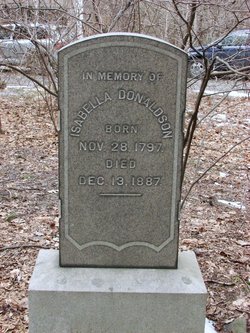
Isabella Donaldson (1797-1887) was at the school for two sessions in 1812.

Joanna Donaldson (1806-1876) was at the school for three sessions, 1816-1817.

As the details already given suggest, even in 1996 I had found a lot of information about these girls.  Eliza Donaldson Hooper stayed with her former teacher Rachel Mordecai Lazarus in Wilmington during her final illness.  Isabella Donaldson (the eldest sister to attend the school) was a lifelong friend to the Mordecais, especially to Julia Judith Mordecai. Caroline mentions Isabella Donaldson in an 1842 letter to the writer Maria Edgeworth, and Isabella wrote to inquire if Ellen was interested in a governess job with a neighboring family that same year.  Joanna Donaldson enjoyed a visit from the Mordecai women in 1842, when her husband Oliver Bronson was unwell.  It's clear that the Mordecais considered the Donaldsons admirable, unlike a lot of their students' families:
[Julia] is happy to be with me, but she cannot find anything in the society of Wilmington to compensate for the delightfully rational hours spent with the Donaldson family.  I wish they resided here, such intercourse is enviable, & preferring it as we do, how seldom has it been our lot to taste the enjoyment. (Rachel to Ellen, 18 January 1824, in the Mordecai Family Papers, SHC)

I may say with truth whenever I have visited Mr. Donaldson's family I have left it with the most delightful sensation of calm tranquility I ever experienced in any society.  I believe you know Mr & Mrs. D were from home but Isabella & James were there... (Ellen to Caroline, 18 July 1832, Jacob Mordecai Papers, Duke)
So there were letters and visits, long after the school years.   Their brother Robert Jr. was a prominent banker and arts patron in New York, which offers another window into their later lives.

Isabella Donaldson's gravesite
in Duchess County, New York
via FindaGrave

Robert Donaldson Sr. was a wealthy Scottish merchant, part of a community of prosperous Scots in Fayetteville.  He died in July 1808, and his wife Sarah Henderson soon followed. 

Joanna Donaldson Bronson was only two when her father died; she was ten when she went to the Mordecai school with her older sister Eliza (who was thirteen at the time).  Joanna moved to New York with her brother Robert.  In 1833 she married Dr. Oliver Bronson, from a wealthy family in banking and insurance.  They had a sons Isaac (1835-1872) (who was with the Union Army during the Civil War), Oliver Jr. (1837-1918), Willett, and Robert.  A niece described Joanna as "a beauty in her youth---Black waving hair, beautiful grey eyes and much color of complexion --- very gay and very entertaining. She became very deaf (in her old age) but was so agreeable that everyone sought her society."  Dr. Bronson stopped practicing medicine and became superintendent of schools, eventually moving to Reconstruction-era St. Augustine, Florida as a school administrator.  The Bronsons were benefactors of a missionary society, a girls' school, the American Tract Society, and an "Asylum for Respectable Aged Indigent Females."  Their house in the Hudson Valley is now a national historic landmark.  Joanna was widowed in summer 1875 and died in early 1876, age 69.


Monday, September 2, 2013

123 and 124. Eliza Davis and Eliza Davis

I have two students named Eliza Davis listed as Mordecai students in the appendix of my dissertation.  (Ask any teacher, there's often one or two duplicate names in a school, especially if it's relatively limited in the range of cultural traditions represented. I once had two Rachel Howards in different sections of a course I was TAing at Wisconsin, for example.)

Eliza Davis of Richmond VA attended the school in its last year (both sessions of 1818), with a Major Davis as the adult on the account.

Eliza. Davis of Warrenton NC was married by 1817 (so she's not the above Eliza Davis); she attended the school for four sessions, 1812-13, and has Buckner Davis as the adult on her account.

The second girl is easier to identify, because she lived in Warrenton and the Mordecais shared news about her long after her school days.  Betsy Davis Christmas (as she was usually known) was the daughter of Buckner and Nancy Chapman Davis.  She married Thomas H. Christmas (brother of fellow students Jane and Sarah Christmas) in February 1817, apparently against her parents' wishes.  Within months it was already known in the community that he treated her cruelly.  I don't usually include long excerpts from letters here, but in this case, they tell the tale:

18 September 1817, Ellen to Solomon, from Warrenton:  "You will think with us that her disobedience is if possible too soon punished when I tell you that the unfortunate Betsy Davis (that was) has already been treated so cruelly by her husband as to be obliged to fly from his house and seek a protector in the overseer.  He brought her to Dr. D's where she remained a day, withstanding all Mr. C's entreaties to return with him until the evening.  When he cried and made many concessions which I suppose at length prevailed with her. Her poor father has just returned from the Springs with his health much improved.  He was sent for to town and wished to take her home with him but was persuaded not." (Mordecai Family Papers, SHC)

22 June 1820 Ellen to Solomon: (death of Buckner Davis mentioned) "soon after his death his son became deranged, & Betsy was so much afraid that her husband would return & beat her ill that she left her father's house and lives now at P. Davis's plantation under the protection of Steed the overseer!"(Jacob Mordecai Papers, Duke)

3 March 1826, Ellen to Solomon (from Warrenton):  "I told you in my last letter that the shooting match would probably prove fatal to Tom Xmas but he is on the recovery, and Dr. Davis is bailed until court for $10,000."  (Betsy's cousin* Dr. Stephen Davis shot Thomas Christmas, but both men survived.) (Jacob Mordecai Papers, Duke)

(The story of Stephen Davis shooting Thomas Christmas also appeared in the newspapers.)

12 May 1826
, Caroline to Ellen, from Warrenton:  "T. Christmas going through the street after his wife with a stick in his hand....some of the ladies begged him to go to bed in one of the downstairs chambers, he abused his wife most shamefully & swore he would kill her.  Mrs. Soln Green got in his lap & said she would sit there to keep him from going....at breakfast he scarcely spoke civilly to anyone & immediately got up in his gig and went off with poor Betsy at full gallop.  After he got home he was very furious breaking everything to pieces, after dinner his wife ran to Mr. Ransom's & begged them to hide her...Betsy in the meanwhile had gone to Mr. Somervilles...It is said he did whip her that night whether true or not I do not know." (Mordecai Family Papers, SHC)
13 January 1827, Caroline to Ellen:  "[Mr. Anderson] told us of Tom Xmas having shot a man, one of the Nunneries' apprentices... The man bled a great deal but is now nearly recovered.  TC was taken up the next day & carried to court."  (Jacob Mordecai Papers, Duke U)

22 January 1827?, Ellen to Caroline, from Virginia: "I have been thinking of her Betsy Xmas ever since I read your letter... You remember the day we came away she said to me, 'I think sometimes no one in the world remembers or cares for me."  Poor girl--poor girl--I hope her husband may be sent away where at least he can abuse her no more." (Mordecai Family Papers, SHC)
 5 March 1827, Caroline to Ellen, from Warrenton:  "You will be sorry to hear that poor Betsy Xmas is in town she came to Judge Hall's on Tuesday night or rather Wednesday morning for she walked all night long and came alone. Sally told me she looked dreadfully & is very much bruised & she has not eaten a mouthful the day she left home... He has sent for her two or three times but I do not believe she has gone yet." (Jacob Mordecai Papers, Duke U)
12 May 1829? 1828?, Caroline to Ellen, from Warrenton:  "Tom Christmas is out of jail his mother & brother stood his securities."


After this point, Caroline Mordecai Plunkett moved out of Warrenton, and there were no longer any members of the family there to report on Betsy Davis Christmas's fate.  However, we can pick up the story in other records.  It looks like Tom Christmas had other incidents of violence within the family; his son killed a brother-in-law,* and Tom himself was convicted of murder in 1839, after killing his wife's cousin Richard Davis.*  A state supreme court case, Christmas v. Mitchell (1845), establishes that both Betsy and Tom were dead by the time the case was brought (involving the ownership and inheritance of slaves in the Davis/Christmas family). We also learn from that court document that their eldest son Leonidas was deaf from birth, and had never received an education.

The specifics are a little fuzzy, but taking several versions together gives a general picture of her life. This family history has Elizabeth Chapman Davis Christmas dying in 1842, the mother of five sons all born between 1817 and c1825. (But I think the birthdate is wrong there. She wasn't born as early as 1780; the same chart has her parents marrying in 1800.) The same family history has Thomas Christmas dying in 1842 as well.  This family history has Elizabeth (Betsy) born c1797, and shows her as Thomas's second wife--it shows him with a first marriage that lasted less than two years.  This one also shows the first brief marriage, with a child born in 1816. This family history has her with eight children, mostly sons, born 1817-1837, and has her a widow for two years before she died in 1842.

*Facts marked with an asterisk above are corrections made by Mr. Shannon Christmas, 9/3/13, a Christmas family historian--see first comment.

I'll come back for the other Eliza Davis soon.  Betsy Chapman Davis Christmas's story is a lot to deal with in one blog post.

UPDATE May 2024: Thank you again to Shannon Christmas for a link (in comments) to a newspaper death notice for Eliza Davis, wife of Thomas H. Christmas, giving 31 January 1830 as her date of death. 

Sunday, July 29, 2012

93.-94. Jane and Sarah Christmas

Two girls named Christmas are on the rolls for the Mordecai school. Jane Yancy Christmas is listed attending for three sessions, I think (1813a, and both 1815 sessions); Sarah Christmas is there for three other sessions, one overlapping with Jane (1812a, 1813b, 1815a).  Both have Lewis Christmas as the adult name attached to the account.

The Christmas family were locals in Warrenton; there is still a Christmas family historical house standing (barely) in town.  The Mordecais who stayed in the area mention the family's doings in their letters.  One hair-raising report finds a drunken "T. Christmas" chasing his wife through the streets with a stick, breaking down doors and signs, even beating a man in his rage, because Betsy Christmas danced with another man at a party.  (Caroline Mordecai Plunkett to Ellen Mordecai, 12 May 1826, Mordecai Family Papers, Southern Historical Collection; stay tuned, because Betsy Davis Christmas was a Mordecai alumna too--more on here in a few entries.)  A later letter indicates that this man's problems continued:  "Tom Christmas is out of jail, his mother & brother stood his securities." (Caroline Mordecai Plunkett to Ellen, 12 May 1828?, Jacob Mordecai Papers, Duke University)


Well, I can't complain about it being a common surname this time, but it's also not an easy name to google.  Nonetheless, because they're local and Warrenton isn't a big town, they're pretty easy to track down.


Jane Yancy Christmas (c1798-1820) was the daughter of Jane Yancey(1774-1845) and William Christmas (1766-1804); her mother remarried, so Jane also had a stepfather, Captain John Green (to make this family a little more complicated, John's first wife was William Christmas's sister, Martha). Jane was born and died in Warren Co., NC.  Her brother was Lewis Yancey Christmas.*  As their father had died by the time Jane and Sarah attended school, it makes sense that Lewis was the tuition payer in the school ledger. 

Her sister Sarah Christmas married John H. Marshall in 1818.  Sarah sometimes appears as Lucy D. Christmas in family histories, but with the nickname "Sally."  The names Lucy and Lewis could be confusing on siblings, and maybe she preferred a more distinctive sound?  She's "Sally D. Marshall" in a bit of 1820 paperwork about land.  I can't find a record of children or a death date for either Sally or John Marshall; they may have left the area.


*Lewis Y. Christmas freed a group of his slaves, acknowledged to be his own children and grandchildren, in his 1859 will, and left funds for them to be transported safely to a non-slave-holding state (or Mexico).  The will was contested by Lewis's white kin, but it was upheld in court.  The Christmas family, black and white, still has reunions that they call "Christmas in July"--here's a report from a recent gathering