Showing posts with label marriage. Show all posts

Tuesday, January 28, 2025

201, 202. Arthur Brehon Gloster (1799- ) and Elizabeth Gloster Anderson (1796-1873)

There were two local students named Gloster at the Mordecai school in its early years; Arthur Gloster was there in 1809 and 1810, and Elizabeth Gloster was there from 1809 through 1811. Both were the children of Thomas Gloster, an Irish-born local physician in Warrenton, and his wife, Mary Hayes Willis Gloster. These siblings both had paragraphs in my dissertation appendix, so much of the following is taken from there.

In 1996 I knew that Elizabeth Willis Gloster was born in 1796, married Jack Anderson in 1814, had about ten children, was widowed in 1848, and died in 1873. (I encountered her more during my post-doctoral work in the Cameron Family Papers, because Jack Anderson was a Cameron cousin.) Elizabeth Gloster Anderson attended the last "reading of the cards" at the Mordecai school in 1818, saying that she had also been there for the first such event. She was also at the school's last examination. Elizabeth Gloster Anderson raised the daughter of her classmate Eliza Adam Cameron, and was close to Caroline Mordecai Plunkett into the 1820s.

Elizabeth (also known as Betsy) moved to western Tennessee in 1827, with her husband and children, and her mother and brother too. She had asthma, and found Tennessee's climate more healthful, and reported in her letters that she was walking seven or eight miles without being fatigued. Her husband started an Episcopal church there. Caroline Mordecai Plunkett also moved to western Tennessee, in 1833, and Betsy taught drawing at Caroline's school there. So she's one of the Mordecais' first students, and one that continued her connection to the family well into adulthood, and across many miles. She moved to Texas in 1859. Her papers are in the Southern Historical Collection at UNC.

Elizabeth's younger brother Arthur Brehon Gloster, born 1799, went to West Point Military Academy in 1819, but he did poorly on exams and was back in Warrenton by 1821. He moved to Tennessee when the Andersons did, and married a cousin, Mary, in 1829. Arthur and Mary ran a tavern in La Grange, Tennessee, and had at least eleven children, all born and baptized in Tennessee, according to the family Bible I looked at in Warren County. Most of them died young; the only living son at the time of the Civil War died as a soldier for the Confederacy.

(Although the Mordecai school was considered a girls' school, there were some male students, usually young boys from Warrenton who had a sister or other female relative also attending.)

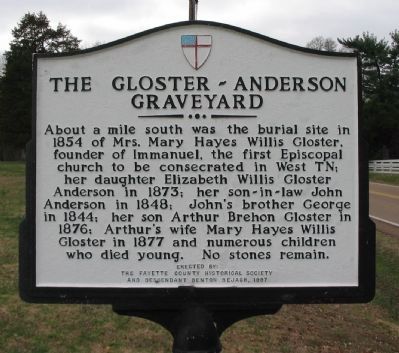
The family's Tennessee graveyard has a historic marker, though the stones do not survive.

Want to see a quilt that Elizabeth Gloster Anderson made in 1844? Sure you do! The Henry Clay Estate at Ashland has this one, a political quilt supporting Henry Clay:


Friday, November 29, 2024

199, 200. Claudia J. Gilmour Johnson and M. Gilmour

We are reaching the milestone of the 200th name on the list (more or less, considering--some of the students may be listed with two different names, because of handwriting or name variations).  The roster of Mordecai students I compiled in 1996 has two named Gilmour: Claudia Gilmour of Halifax County, North Carolina, who was at the school in its first session 1809, and then again from second session 1810 to second session 1813; with William Gilmour as the adult name on the account; and M. Gilmour, who was only there in 1809.

Even in 1996, I knew enough about Claudia J. Gilmour Johnson to give her a paragraph in the "Brief Biographical Sketches" appendix of my dissertation. She married Haywood Johnson in 1819 at Petersburg, Virginia; Rachel Mordecai apparently suspected that the match was against their family's wishes. They lived on a farm outside Warrenton, and were friends with Caroline Mordecai Plunkett there in the 1820s. They had a son, Arthur Gloster Johnson. Like a lot of other Warrentonians and Mordecai alumnae, she moved to La Grange, Tennessee, with her family, and helped run a girls' school there. She died by 1835.

So, that's a pretty good start! Let's see what we can find online now.

Eh, not that much, really. I thought her somewhat unusual first name and all the geographic details would help, but "Johnson" is a tough last name to work with. Claudia Gilmour may have continued as a student at Raleigh Academy after leaving Warrenton; a student with that name excelled in drawing and music at the Raleigh Academy examinations in November 1815.

But as for her birthdate? Grave site? Parents? I'm coming up blank. And that "M. Gilmour" might be a sibling, but without the rest of Claudia's picture, it's hard to say. Maybe you know more about these 19c. "Gilmour Girls", blog reader?

Sunday, June 30, 2024

194. Mary R. Gee (might be Mary A. Gee)

 There is a student named Mary R. Gee in the list I made for my dissertation's appendix in 1996. She was from Halifax County NC, attended the Mordecai school for four sessions, from early 1816 to the end of 1817, and the named Neville Gee is associated with her account.

Let's see what the online sources can tell me about this student now. Okay, this one is easier than Virginia Gaulejean(?). I think? Not 100% sure, but this is what I think I've pieced together, mostly on Ancestry:

Neville Gee (1773-1828) of Halifax County NC married Elizabeth Harwell, and had eight children, including Mary. Elizabeth Harwell Gee died sometime in the 1810s. Mary Gee was sent to the Mordecai school in 1816 and 1817; sometimes school enrollment was a way to manage the children of a grieving household.  Or maybe her father was making social connections; the Alston family had several daughters at the Mordecai school over the years, and he was remarried to Elizabeth M. Alston in October 1817. 

Mary Gee married Hutchins B. Mitchell in 1821. In 1828, her father died in Wilcox, Alabama. Did she also move to Alabama? I lose track of her after 1821. Do you know her fate? Leave me a comment.

Friday, May 31, 2024

191, 192. Clara and Rosa Garnier

There are two Mordecai students named Garnier in the appendix of my dissertation. Clara and Rosa Garnier may have been from Wilmington, North Carolina; they both seem to have attended from early 1811 to late 1813, and John Garnier is the adult name attached to their account.

Well here's a first: I think Clara Garnier might be the first Mordecai student (that I know of) who was born outside of the United States.  Clara Louise Garnier (c1800-1867) was born in Bordeaux, France (according to her tombstone), and emigrated with her father John Garnier and mother Ann Rosalia Boutet to the United States, settling in Wilmington by 1805. Her mother died in 1810 (which might explain why both girls arrived at the Mordecai school in the beginning of 1811). She married in 1822, to businessman George W. Barkley. They lived in Pensacola, Florida, and had nine children born between 1823 and 1838. Here's a photo of her daughter and namesake, Clara Garnier Barkley Dorr (1825-1899). Clara's granddaughter, Martha Sawyer Gielow, was a writer and public speaker, founder and director of the Southern Industrial Association.

Rosa B. Garnier (c1804-1842) was Clara's younger sister. She married Dr. John O. Smith, and died in 1842, at age 38.

The Barkley House, where Clara Garnier Barkley lived, still stands in Pensacola.


Sunday, April 28, 2024

190. Marion Galloway

There's a student named Marion Galloway in the list of Mordecai school students I compiled in the 1990s. She may have been from Halifax County, North Carolina, attended the school from the beginning of 1817 to the end of 1818, and a Robert Galloway is the adult name attached to her account. Not much to go on, but let's see how much more we can learn about her now...

One thought: Marion is not a very common name for the students at the Mordecai school. Mary, Mary Ann, sure, but I don't see other Marions in the list. So I'll definitely check other spellings.

Here's one potential match: Marion Galloway, daughter of Robert Galloway and Mary Spraggins Galloway; her father was a Scottish immigrant and died in 1832. He lived in Rockingham County NC, owned a tavern at Wentworth, and in the 1820 census there are 77 enslaved people recorded at his plantation. In his will, her name is clearly written "Marion" (see snippet from Ancestry).  And she is listed as the wife of James E. Galloway--so she may have married a cousin, or otherwise landed with a matching maiden name and married name. She and her husband were given land in Tennessee, and a dozen enslaved people, in her father's will.

"I give to my daughter Marion, wife of James E. Galloway, in fee-simple, the following tracts of land..." from the will of Robert Galloway of Rockingham County, NC, dated December 1831

Her husband died in 1833, in Maury, Tennessee, leaving her a young widow with a young daughter, Cornelia, and son, James A. Galloway. James E. Galloway's will is also on Ancestry; here's where she's named ("my dearly beloved wife Marion Galloway"), along with her two children. Her brothers-in-law, Samuel W. Gentry and Reuben A. Gentry, were the will's executors.

The timing, name, class, and locations match up fine; this very well could be a Mordecai student. But I don't have quite enough to feel like this is a definite match.

Wednesday, March 20, 2024

188, 189. America Fuqua and Saluda Fuqua

Well, nobody can say these two students had common names! America Fuqua and Saluda Fuqua were students at the Mordecai School in its later years, 1816 to 1817 for America, and 1816 to 1818 for Saluda. The adult name attached to their account is Samuel Fuqua. Also, my dissertation appendix says that Saluda was born in 1805, and died in 1886. So that's a lot to start with, for a change... 

America and Saluda were the daughters of Captain Samuel Fleming Fuqua (1787-1820) and Prudence Ford Fuqua (1787-1813). A few years after their mother died, their father placed them at the Mordecai School. 

Saluda Baker Fuqua (1805-1886) was born in Charlotte County, Virginia, when both of her parents were 18 years old. She was 16 when she married William Henry Browne Christian in 1821, the year after her father died. The Christians had six children. After she was widowed, she married again in 1847, to William Harloe Watson, and had one more child. She lived in Douglas County, Kansas, in her later years, and died there in 1886. Her eldest daughter America Fuqua Christian (born 1824) married Daniel Woodson, who was the acting Territorial Governor of Kansas several times in the 1850s.

Saluda's younger sister America E. Fuqua (born 1810) was a student at the Mordecai school when she was a small child of 6 and 7 years, but her older sister was also there. She died young, before 1830.

These girls had another sister, Evaline Ann Frances Fuqua (1807-1832) But I don't see any evidence of her attending the school, and she may have had chronic health issues. Evaline lived with Saluda and W. H. B. Christian in her last years. Their only brother, La Marquis Washington Fuqua (1810-1846, known as Marc) also died young.

A last note: The source of America's first name is obvious, but Saluda's name origin may be less so. Saluda River, Saluda Mountains, Saluda, North Carolina, and Saluda County, South Carolina, are all Southern placenames, but not very close to where Saluda Fuqua was born or lived. (There is also a Saluda, Virginia.) But the name seems to come from a Cherokee word,
Tsaludiyi, meaning "green corn place".

Wednesday, February 28, 2024

181-187. The Freemans

There were seven students named Freeman in the Mordecai school roster I assembled in the early 1990s:

  • Eliza Freeman (one session, 1812)
  • George Freeman (four or five sessions, 1809-1811)
  • John Freeman (1811, both sessions)
  • Maria Freeman 1809-1810, three or four sessions)
  • Martha Freeman (1812, then 1816-1817, four sessions total)
  • Mary/Polly Freeman (1810, both sessions)
  • Sarah/Sally Freeman (1816, both sessions, and 1818, both sessions)

Okay, so: two boys, five girls, most attending early in the school's run, but a few (Martha and Sally) attending later in the school's existence. All one family? Two or more families? I'm going to assume the Freeman boys are from a family lives near Warrenton (boys would have been day students). I don't have much more about any of these children in my dissertation notes. So let's see what some googling and ancestry.com can tell me now.

Hm, not much. Common names and not a lot of context, but here are some leads for starters.

A George W. Freeman was principal of Warrenton Academy in the early 1820s; I'd be surprised if none of these Freeman children had any connection to him, but... I'm not finding it right now.

Maria could very well be Maria L. A. Freeman, born 1795,  the daughter of Robert Freeman and Sarah Freeman. She married John Snow in 1812 in Warrenton, and had two children, Theophilus Hunter Snow (born 1813 or 1814) and Emma J. Snow (born 1815).  Her husband died in 1819, in his thirties; there were four enslaved people mentioned in his will (Tom, Ephraim, Shadrack, and Pinny). As Maria A. Snow, she appears as head of her household in Warrenton in the 1820 census, with her young children and three slaves. In 1823, she remarried to Alexander J. Lawrence, in Franklin County, and had two more children, Alexander Lawrence and Anna Lawrence. In 1843, her elder son was vice-president of the Raleigh Temperance Society. In the 1850 and 1860 censuses, the Lawrences are keeping a hotel in Raleigh with their daughter Anna. In the 1870 census, she is still alive, living with her second husband in Raleigh; both of their children and two Snow granddaughters also live with them. In the 1880 census, she is a widow again, and living with her son Alexander in Raleigh.

UPDATE: From Shannon S. Christmas in comments: "Sarah Freeman, daughter of Robert Freeman and possibly Sarah Green, was the wife of Adam Hawkins (son of Philemon Hawkins and Mary Christmas) of Franklin County, North Carolina. After marrying in Franklin, the couple appears to have relocated to Tennessee's Haywood County, before settling in Mississippi's Marshall County. Adam Hawkins died prior to 1856, leaving his widow to raise their children in Mississippi. Sarah died after 1860."

 Thanks Shannon S. Christmas!


Monday, January 29, 2024

180. Nancy Franklin (1795-1874?)

There is a student named Nancy Franklin in the roster of Mordecai school students in my 1996 dissertation. It says she was at the school in 1814.

I suspect she might be this Nancy Franklin: Ann P. Franklin (1795-1874), daughter of Jesse Franklin and Maria Perkins Franklin. Jesse Franklin was governor of North Carolina from 1820 to 1821. When Nancy was at school, Jesse Franklin had just finished a term in the United States Senate. She married William Slade in Surry County, NC, in 1821? That's a perfect year for an 1814 student to be marrying, in North Carolina. She was later known as Nancy P. Slade, lived in Rockingham till at least 1870, and had at least five children. Her husband William Slade died in 1865. (1850, 1860, 1870 censuses, via Ancestry) 

Besides the good timing, there was also a student named Helen B. Slade at the Mordecai school, also in 1814, and also from Rockingham. So if Mrs. Slade is, indeed, the Mordecai student Nancy Franklin, she married into a classmate's family, which is pretty typical. 

If we have the right Nancy Franklin, one of her sons, Jesse Franklin Slade, died at the Battle of Gettysburg during the American Civil War.  Her two daughters died before that, both in their 20s. And two of her sons survived her, Thomas Howard Slade and William B. Slade.

And if this is the right Nancy Franklin, here's her grave in Caswell County, North Carolina.

Thursday, July 14, 2022

179. Mary (Polly) Fowler (1799-1850)

There was one student named Fowler in the rolls of the Mordecai school. Mary (Polly) Fowler (1799-1850) was born in Virginia, and attended the school during its first three years, from 1809 to the end of 1811. She married Archibald Daniel Burrows in 1820. They lived in Warren County, North Carolina, where the 1830 federal census found their household included 9 "free white persons" and two women who were enslaved. They had at least five children: William, Letitia (Bobbitt), Mary Rebecca, James, and Tom. Their youngest, Mary Rebecca, was born the same year Archibald died, in 1835. Polly Fowler died in 1850.


Wednesday, October 13, 2021

176, 177, 178. Charlotte Fort (Gorman), Mary Ann Fort (Mason), and Martha Fort (Andrews)

 There are three girls named Fort in the rolls of the Mordecai school that I assembled in the early 1990s:

Charlotte Fort attended the school in both sessions of 1811.

Mary Ann Fort attended the school for three years, from early 1816 until the end of 1818. She was from Hicksford (now Emporia), Virginia, with Lewis Fort as the adult name on her account. She married in 1821.

Martha (or Patsy) Fort attended the school for two years, from early 1810 to the end of 1811.

Mary Ann Fort Mason (1803-1870) I was able to learn about in the early 1990s, because she married someone fairly prominent, and because she was at the school long enough to be mentioned in the Mordecai letters. Rachel Mordecai called her parents (Lewis Fort and Eliza Harris Coleman Fort)  "quite diverting people" and noted that her mother wrote "droll letters". Her planter family held slaves. At age 18, in 1821, she married John Young Mason, whose sister was a Mordecai student. They had at least eight children together, and her husband became a congressman, and an ambassador, and Secretary of the Navy, and Attorney General of the United States--so she was a busy political wife, until he died in 1859, in Paris. At least one of her sons (Simon Blount Mason) served in the Confederate army during the Civil War. She died in 1870, in Virginia.

Now what can some online searching reveal about the other two Fort girls?  Charlotte Ann Fort married John S. Gorman in Wake County, North Carolina in 1818--the age/timing is exactly right for that to be the Mordecai student. AND she had a sister Martha Fort. Aha! So we have them.

Charlotte Ann Fort Gorman (1802-1883), daughter of James Fort and Chloe Powell Fort, married John Spear Gorman in Wake County in 1818. They had at least one child, Annie, in 1832. Charlotte was widowed when J. S. Gorman died in 1836. She died in 1883, aged 81 years.

Martha W. Fort Andrews (1797-1876) was Charlotte's older sister. She married Cullen Andrews Jr. in Wake County in 1816, and they had ten children born between 1817 and 1837. The Andrews family lived in Tennessee, Mississippi and Alabama. Her husband died in Texas in 1857. Martha Fort Andrews died in 1876, aged 79, in Columbus, Mississippi.

All three Fort girls were Southern widows in their 60s when they lived through the American Civil War.

Sunday, August 8, 2021

174. and 175. Ann (Nancy) and Eliza Foote

Hello again! Okay, yes, it has been three years. I'm pretty active on Wikipedia, writing biographies of women, and most days that takes all my keyboard time, but I DO want to return to the blogs too. I no longer have a searchable version of my notes from the Mordecai papers (originally typed into MacWrite II in the early 1990s, so... yeah). But maybe I can still do this. Let's see.

After the big clump of students named Fitts, there are two girls named Foote: Ann (or Nancy) and Eliza, both attached to the adult name "Adam Foote". Here's what I had about them in my dissertation appendix in 1996:

    Ann (Nancy) Foote of Warren County, NC attended the Mordecai School in 1815, 1817, and 1818, for  a total of three non-consecutive sessions. She married in 1831, and died in 1892.

    Eliza Foote was at the Mordecai School from 1814 to mid-1815, for three consecutive sessions.

Not much. And their names aren't so distinctive, but let's give it a go.

Looks like Nancy Foote Brame (c1805 - February 1892), was the daughter of Henry Alexander Foote Jr. and Mary Moss Foote. She married Marcus G. Brame, and lived in Marengo County, Alabama. She was married in 1831, had six children, and was widowed by 1845. In the 1850 United States Census, she was listed head of her household, and owner of seven slaves, in Perry County, Alabama. Ten years later, in the 1860 census, she appears as owner of twelve slaves, living in Lowndes County, Mississippi (just over the border from Alabama).  If that death date of 1892 is correct, she was probably one of the last living Mordecai students.

She doesn't seem to have had a sister named Eliza, but there were a lot of Footes in Warren County, including historian William Henry Foote; there's even an abandoned Foote Cemetery in Warren County.

Next up: the Forts.

Tuesday, May 8, 2018

166.-173. The Fitts Family (Caroline, Elizabeth, John, Mary, Susan, Susan, Tempe, Winnefred)

Hello, it's been a while! Maybe I was intimidated to return, knowing the Fitts family was next alphabetically. Well I'm feeling ready to face them now. There are eight students named Fitts in the rolls of the Mordecai school that I compiled over twenty years ago. They were the children of Henry Fitts (1778-1847) and Oliver Fitts (1771-1816), Warrenton residents. Oliver Fitts, who served in the NC legislature, sold his house to Jacob Mordecai to use for the school in mid-1811, so several of these children attended school in a building that was once their father's property. Here they are, set in their sibling groups:

Henry and Sarah (Sallie) Duke Fitts' children:
Caroline Fitts (1803-1846), attended the school in 1812
Elizabeth Fitts (1805-1884), attended the school in 1812
Mary Parham Fitts (1799-1856), attended the school 1809-1812
Susan Fitts (1800-?), attended the school 1809-1811
Winnefred Fitts (1802-1870), attended the school in 1812

Oliver and Sarah Harris Fitts' children:
Susan Brown Fitts (1798-1887), attended the school 1809-1812
Temperance Winnefred Fitts (1802-1870), attended the school 1809-1815

There's also a boy named John Fitts (1804-1882), attended the school 1809-1813; might be a cousin?

(Yes, two Susans and two Winnefreds. Temperance Winnefred went by the nickname "Tempe.")

Now, let's get to know more about these students using some online resources:

Caroline Fitts Palmer (1803-1846) married Horace Palmer (1801-1882) in 1838, as his second wife; they had children Sarah (1840-1929) and William (1844-1909) together; Horace Palmer also had four sons from his first marriage. Caroline died in 1846, aged 42 years, in Warren County NC.

Elizabeth Fitts Milam (1805-1884) married Nathan Milam (1802-1870) in 1827.  They had a son Henry Duke Milam (born 1831). They stayed in Warren County, where Elizabeth was widowed in 1870 and died in 1884.

Mary Parham (Polly) Fitts Rogers (1799-1856) married Zachariah Milam in 1819, and married Colonel George Rogers in 1823. With Rogers she had four children, Emily (1823), Thomas (1824), George (1826), and Adeline (1830). They lived in Mecklenburg County VA. She died in 1856, aged 57 years.

Susan Fitts Twitty (1800-after 1854) married John Eldredge Twitty. They had children together: Henry (1822), William (1825), Mary Ann (1827), Caroline (1829), Sallie (1831). Susan Fitts Twitty founded the Sunday School at Hebron Methodist Church in Oakville NC in 1854.

Winnefred Fitts Drake (1802-1870) married Matthew Mann Drake. They had children together: Henry (1828), Mary Ann (1830), William (1832), Sallie (1835), and John Oliver (1837). She died in 1870, aged 68 years, in Warren County. Her son Maj. William Caswell Drake, a Confederate Army veteran, became superintendent of schools in Warren County in 1885. Her daughter Sallie Duke Drake Twitty (1835-1923) was a Civil War widow and a longtime teacher and school principal.

Susan Brown Fitts Ripley Comegys (1798-1887) moved to Alabama in 1816; in 1818 she married Daniel B. Ripley. They had two children together, FitzHenry Ripley and Sarah Ripley. Sarah died and in 1823 Susan was widowed. She visited her former inlaws in Boston in 1826, with FitzHenry in tow.  In 1834 she married again, to Edward Freeman Comegys (1797-1875), a bank officer. They had two sons together, William and Edward. Susan was widowed again in 1875. She died in 1887, aged 88 years, in the home of her only surviving son, Edward, in Denton TX.

Temperance Winnefred Fitts Crawford (1802-1870) was one of the Mordecai's first and longest-running students, attended their school from ages 7 to 13. In 1819 she married William Crawford (1784-1849), a bank president and judge 18 years her senior. They lived in Alabama and had two daughters together, Susan (1821-1863) and Caroline (1823-1841). When she visited Emma Mordecai Myers in 1850 she was a recent widow. She outlived both of her daughters, too, by the time she died in 1867, aged 65 years.

Nearly all of these sisters and cousins had children who married the children of others on this list.

Wednesday, December 7, 2016

163, 164. Eliza and Harriet Field (and maybe 165. Another Eliza Field?)

Two students named Field are in the rolls of the Mordecai school, both from Mecklenburg, Virginia, both among the first students when the school opened in 1809. Eliza Field and Harriet Field were both at the school for six sessions, on and off between 1809 and 1813 for Harriet, 1814 for Eliza.

These might be Harriet and Eliza Field, the daughters of judge Hume Riggs Field (1772-1831) and his first wife Millicine (or Mildred) Young Field (1782-1827), of Mecklenburg Virginia.  The dates might not work out, though: Harriet H. Field was born in 1800--so she was nine the year the school opened, that makes sense. Eliza, however, was younger--born in 1806--maybe too much younger to be a Mordecai student in 1809.

If Harriet's sister Eliza was the Eliza Field at the Mordecai school in 1809, she would have been three years old, and the youngest known student. So I suspect she was the Eliza who attended after 1812; but a different Eliza Field, maybe a cousin, might have been there in 1809 and early 1810. The name isn't so unusual, anyway. Assuming the daughters of Hume and Millicine Field attended the Mordecai school...

Harriet H. Field (1800-1850) married Charles Perkins in about 1821, and they had at least one child, Marietta. She was widowed around 1828, and died in Tennessee in 1850, aged 50 years.

Eliza Mildred Field (1806-?) married Charles Perkins' brother, Constantine Perkins (1792-1836) in about 1824, and they had at least three children, Constantine, Ann Eliza, and Virginia in Tuscaloosa, Alabama. Her husband served in the Alabama legislature, and as the state's attorney general.

Friday, November 18, 2016

162. Eliza Geddy Fenner Vaulx (1799-1845)

There's a student in the rolls of the Mordecai school named Eliza Fenner. She was at the school for a year, two sessions, mid-1810 to mid-1811. That's all I've got. But it turns she's not hard to find with just that bare minimum of detail.

Eliza Geddy Fenner, the daughter of Dr. Richard Fenner (1758-1828), and his wife Ann McKinnie Geddy Fenner (1769-1852). Fenner was the first president of the North Carolina Medical Society. Eliza Geddy Fenner was born in Franklin County, North Carolina, in 1799, which would make her exactly the right age, class, and location for a child at the Mordecai school in 1810.

Eliza Geddy Fenner married James Vaulx (1783-1862).  They had four daughters and a son; two of the daughters died in childhood. They moved to Tennessee, where Eliza is buried (here's her Find a Grave site).  Her son James Junius Vaulx became an Episcopal clergyman in Arkansas and briefly in West Palm Beach, Florida.

And Eliza Geddy Fenner Vaulx was apparently the great-great-grandmother of Arizona senator John McCain, through her granddaughter Katherine Davey Vaulx McCain (1878-1959).

Monday, May 16, 2016

161. Elizabeth Margaret Felder Pou (1806-1853)

There was a student named Eliza Margaret Felder in the rolls of the Mordecai school.  She attended from mid-1816 to mid-1817, and she was from South Carolina. The adult on her account was John Felder.

An Elizabeth Margaret Felder turns up pretty quickly in googling; she was born in 1806 in Orangeburg SC, which would make her age 10 and 11 while she was at the Mordecai school--seems like a perfect fit.  Her parents were Samuel Felder and Ann Horger, first cousins, both of them born in South Carolina.  Eliza's grandparents and great-grandparents were born in Switzerland and Germany. Samuel died in 1813, so the John Felder on her account was likely her older half-brother John Myers Felder (1782-1851). While Eliza was in school, John Myers Felder was serving in the South Carolina Senate.

She married lawyer Joseph Pou (1805-1888; the name was pronounced like "Pew") in 1827, and they had about seven children, two daughters and five sons. She died in Talbotton GA, in 1853, age 47.  Here's her tombstone in the Talbotton City Cemetery.  Her husband remarried.

Eliza's grandson, Edward William Pou (1863-1934), was a longtime member of Congress, serving continuously from 1901 to 1934. Another grandson, James Hinton Pou (1861-1935) served in the North Carolina legislature.

Thursday, March 10, 2016

159 and 160. Susanna (Suky) and Wilmouth Fawn

This month's entry brings us a hard truth about schools in the Early Republic. Even among the most privileged classes, child mortality was a fact of life, and running a school sometimes meant facing a student's death.

There are two students with the surname Fawn in my rolls of the Mordecai school. Suky Fawn (or "Sucky", as I have it transcribed) and Wilmot Fawn. Both were enrolled for only one session (the second half of 1812), and both have a Captain Fawn as the adult name on the account. Suky Fawn died at the school in August 1812.

We'll get to Suky in a minute, but .... Wilmot? I have that student marked as male in my dissertation, because, well, it sounded like a male name. I must not have found any other reason to think that, because (as it turns out) "Wilmot" was Wilmoth L. Fawn (b. 1795 in Franklin NC), daughter of Capt. William Fawn* (1768-1809) (a Revolutionary War veteran) and his wife Elizabeth Harrison (1759-1847) of Franklin, NC. Wilmouth Fawn married Samuel Aaron Devaney (1779-1857) in 1818. Wilmoth Fawn Devaney had at least ten children, all born in North Carolina between 1819 and 1829, except one son, Ellis, who is shown as being born in 1843 (when Wilmoth was 47).  Of her sons, Frank Devaney was a Civil War veteran (CSA), who lived till 1925 in Oregon.  Wilmoth Fawn Devaney died in Roane County, Tennessee in 1854, age 58. (Her name is found, variously, as Wilmouth, Wilmuth, even Wilmarth.)

And Wilmouth's younger sister Susanna Fawn (b. 1799) must have been our unfortunate "Suky". "The death of Miss Fawn must also have been a severe shock," wrote Samuel Mordecai to his sister Rachel in September 1812, "for I can well imagine how it affected you all." (Mordecai Family Papers at the Southern Historical Collection).

*A different (but possibly related) "Capt. Fawn" of Norfolk VA seems to have been the uncle of student Eliza Armistead; but he died in 1818, according to a letter from Rachel Mordecai to her sister Ellen (8 February 1818, Southern Historical Collection.

Sunday, November 8, 2015

158. Sarah Fauquier (Emmerson? b. 1804?)

There's a student on the roster of the Mordecai school that I compiled in the early 1990s named Sarah Fauquier. She's listed as being from Norfolk VA, attending for both 1818 sessions, and having William Fauquier as the adult on her account.

There is a Fauquier County in Virginia--but the name is probably still variously spelled in early 19c. sources, including Farquhar, Forker, Falkier, etc. And Sarah might also be Sara or Sally. But we have a parent(?) name and a city, which is a good start. And attending only in 1818 means she's likely born a few years after 1800--looking in the vicinity of 1805 would be best.

A Sarah Fauquier, daughter of William M. Fauquier, married at Benjamin Emmerson at Norfolk on November 10, 1824--that Sarah seems like a very good candidate, age is a good match, everything else lines up.

A William May Fauquier (1773-1827) was a chemist in Norfolk VA, and appears as "William M. Forguher" in his wife's family bible; he married Ann (Nancy) Benthall in 1801. They seem to be the parents of the same Sarah (Sally) Fauquier Emmerson above; that woman, born 1804, named one of her eight children Anna Benthall Emmerson. William May Fauquier was a deacon at the Baptist Church in Norfolk.

Is she the one? Anyone with further useful information, please share in comments.

Thursday, September 17, 2015

156. Martha Whitmel Falconer Faulcon (1799-?)

There's a student in the Mordecai school rolls named Martha W. Falconer, who attended for both sessions in 1813. (That surname may also appear as Faulkner, Falkener, Falkner, and other variations.) "Alxr. Falconer" appears in the school ledger in July 1813.

Alexander Falconer Jr. (c.1765-1818), born in St. Andrews, Scotland, had about 1000 acres of land in Franklin County, North Carolina, but also had legal training. He attended the Mordecai school's examinations in 1811 and 1812, and was a trustee of the Franklin Academy from at least 1805 to 1815; Moses Mordecai is listed as a witness on Mr. Falconer's will.  In addition to daughter Martha Whitmel Falconer (1799-), he had sons John, Robert, and Alexander, and a daughter Mary Pugh Falconer (c1800-1836).Their mother seems to have been the former Mary (Polly) Harriet Wynne, who also died in the 1810s.

Martha Whitmel Falconer would have turned 14 the year she attended the Mordecai school.  Ten years later, on October 6, 1823, she married Isaac N. Faulcon in Warren County.  They had sons James (1825) Robert (1827), and Jesse (1829). She must have died by 1841, because Isaac married a second time, to a Mrs. Fannie Clanton, that year.  The Faulcons were related by marriage to Alstons, Eatons, Fittses, and other Mordecai families.


A Lucy Faulcon was one of Caroline Mordecai Plunkett's five boarding students in Warrenton in 1828 (Caroline to Ellen, 20 January 1828, Mordecai Family Papers, Southern Historical Collection)--she was no doubt part of the same family as Martha's husband.

Anyone have a deathdate or gravesite for our Martha Falconer Faulcon?

Tuesday, July 7, 2015

153, 154. Jane Evans and Lydia Anna Evans

Two Evans girls were with the Mordecai school when it opened in 1809: Jane Evans was there from 1809 until mid-1811, and her sister Lydia Anna Evans (sometimes written as Lydianna, which might reflect how it was pronounced) was there until the end of 1810.  They came from Oakland, an estate near Petersburg, Virginia, and had Dr. George Evans as the name attached to their accounts in the school ledger.  The Mordecai family discussed the Evans girls in letters, beginning even before their arrival:
"The house is full of girls and... in a few weeks Lidyanna & Jane Evans will come Mrs. Johnson is now at Oakland and they will return with her." (Ellen to Samuel, 16 April 1809, Jacob Mordecai Papers at Duke)
The family were, obviously from their name, Welsh in ancestry. The girls' father Dr. George Evans (c1755-1822).  He moved South from Pennsylvania to Virginia after the Revolutionary War, in which he served as a surgeon.  Their mother was the former Mary Peyton (d. 1818).  The girls' much older sister Mary Evans married William R. Johnson, a notable Warrenton resident, in 1803. (That's the Mrs. Johnson mentioned above and below.)

Marriage announcement, Governor William Miller and Lydiana Evans (1816).
The marriage announcement of Governor William Miller and Lydiana Evans
Weekly Raleigh Register (June 7, 1816): 3.
From Newspapers.com


Lydia Anna Evans (d. 1818) left the Mordecai school at the end of 1810; she married almost six years later, to William Miller, at Chesterfield, Virginia, in May 1816 (see announcement above). William Miller was a Warrenton man, well known to the Mordecais, but at the time of the wedding he was well-known throughout the state--because he was the Governor of North Carolina from 1814 to 1817. (So a Mordecai girl became the first lady of North Carolina while the school was still running.)  Sadly for Lydia Anna, the glamor was very short-lived: she was soon pregnant, had her son William Jr., and she died in March 1818.  (William Jr. soon joined his mother; he only lived to be five years old.) Her widower Governor Miller died in 1825, traveling through Florida on a diplomatic mission to Guatemala.

The Mordecais commented on Lydia Anna's death, of course: 
"We have just received intelligence of the death of Mrs. Miller (Lydia Anna Evans)--So young, so sweet, & so lovely, who can think without pain of her being this early nipped in her bloom. The last letter from Mrs. Johnson mentioned her being much better, & her husband had come out to prepare for her removal to their intended place of residence. Her last illness must have been short for her had not received intelligence of it, & was still absent, when the final event took place." (Rachel to Samuel, 22 February 1818, Jacob Mordecai Papers at Duke)

"The last visitation on the Evans family is a most melancholy one and you are so prone to feel another's woe, that exclusive of the attachment you had for Mrs. M., your sympathy for them must be strongly excited..." (Samuel to Rachel, 1 March 1818, same as above)

"A letter from Mrs. Johnson to Mary mentions that the amiable deceased had left to her the care of her infant, from this I conclude that she was sensible of her approaching fate." (Rachel to Samuel, 1 March 1818, same as above)
Jane Maria Evans:  No sooner had Lydia Anna died, than her sister Jane Evans, also a Mordecai alumna, followed; the Mordecais shared the news:
"You will unite with me in deep & sincere concern when I acquaint you with the new misfortune of the devoted family of poor Dr. Evans--Jane is no more, she expired on the 12th of this month, Lydia on the 13th of last.  Her health had for some time been delicate, and the shock proved too severe for her to bear. Poor Mrs. Johnson appears, as she must be, overwhelmed with grief. Does it not seem indeed too much for human nature to support? I fear it will be impossible for her poor mother to strugle against such an accumulated load of sorrow. When I think of that family as we knew it a few years ago, so cheerful, so happy, so pleased with one another, the girls so gentle, so lovely, and blooming..." (Rachel to Samuel, 22 March 1818, same as above)

"The succession of misfortune in the Evans' family is enough to excite commiseration even in those who feel less interest in their happiness than we do. I had not heard of Jane's death until you mentioned it." (Samuel to Rachel, 29 March 1818, same as above)
But there was still more tragedy for the Evans family in 1818.  That summer, the mother of Lydia and Jane, Mary Peyton Evans, also died. "The unfortunate old lady had never left her chamber since the death of Jane, but has borne her own severe sufferings with entire patience & resignation. She may indeed be said to have fallen victim of a broken heart." (Rachel to Samuel, 26 July 1818, same as above)

Death dates and circumstances are thus well-established; I still don't know when either student was born, or where they might have been buried (I assume a private family plot near the family home at Oakland?).  Does anyone know?

Saturday, May 2, 2015

151, 152. Catharine Williams Epes Green (1802-1887) and Elizabeth Campbell Epes Jones (1803-1880)

There are two girls named "Epes" in the rolls of the Mordecai school.  Catharine/Catherine Epes was at the school for two years, 1813 and 1814; Elizabeth was there for all of 1817.  There's a Thomas Epes associated with Catharine's account, and a William B. Cowan might have been acting as guardian for Elizabeth.  They're from Virginia, from my notes.

Note that the common Virginia surname Epes can also appear as Epps or Eppes.  We've already met one Mordecai girl with the name Eppes as her middle name, Sarah Eppes Doswell Cabell -- so she's a possible school connection to Catherine and Elizabeth Epes too.

So this was maybe easier than I expected:  Catherine Williams Epes Green (1802-1887), daughter of Thomas Epes and Catherine Williams, married William B. Green in 1827.  Catherine's uncle John Epes had daughters Catherine Grace Epes Cowan (who married William Bowie Cowan) and Elizabeth Campbell Epes Jones (1803-1880), who married Richard Jones in 1818.  So Mordecai students Catherine and Elizabeth were first cousins.  Fellow student Sarah Eppes Doswell was another cousin; Sarah and Catherine had their Williams grandparents in common. Elizabeth's mother was John Epes' second wife, so she wasn't truly first cousins to Sarah Doswell, but these families were all very much entangled.  Congressman Sydney Parham Epes (1865-1900) was one of the Epes' girls' distant nephews, and Congressman James F. Epes (1842-1910) seems to be from the same extended family.

How does William B. Cowan come into the story? Elizabeth Epes's father John died in 1816, so it makes sense that her older half-sister's husband, Cowan, paid Elizabeth's accounts at the Mordecai school the following year.

Catherine Epes Green doesn't seem to have had any children in her long life; Elizabeth Epes Jones had about eight children, maybe more.  Both women lived through the Civil War and into old age, and as far as I can tell neither ever lived away from Virginia--except for during their schooldays in North Carolina.