Showing posts with label illness. Show all posts

Tuesday, January 28, 2025

201, 202. Arthur Brehon Gloster (1799- ) and Elizabeth Gloster Anderson (1796-1873)

There were two local students named Gloster at the Mordecai school in its early years; Arthur Gloster was there in 1809 and 1810, and Elizabeth Gloster was there from 1809 through 1811. Both were the children of Thomas Gloster, an Irish-born local physician in Warrenton, and his wife, Mary Hayes Willis Gloster. These siblings both had paragraphs in my dissertation appendix, so much of the following is taken from there.

In 1996 I knew that Elizabeth Willis Gloster was born in 1796, married Jack Anderson in 1814, had about ten children, was widowed in 1848, and died in 1873. (I encountered her more during my post-doctoral work in the Cameron Family Papers, because Jack Anderson was a Cameron cousin.) Elizabeth Gloster Anderson attended the last "reading of the cards" at the Mordecai school in 1818, saying that she had also been there for the first such event. She was also at the school's last examination. Elizabeth Gloster Anderson raised the daughter of her classmate Eliza Adam Cameron, and was close to Caroline Mordecai Plunkett into the 1820s.

Elizabeth (also known as Betsy) moved to western Tennessee in 1827, with her husband and children, and her mother and brother too. She had asthma, and found Tennessee's climate more healthful, and reported in her letters that she was walking seven or eight miles without being fatigued. Her husband started an Episcopal church there. Caroline Mordecai Plunkett also moved to western Tennessee, in 1833, and Betsy taught drawing at Caroline's school there. So she's one of the Mordecais' first students, and one that continued her connection to the family well into adulthood, and across many miles. She moved to Texas in 1859. Her papers are in the Southern Historical Collection at UNC.

Elizabeth's younger brother Arthur Brehon Gloster, born 1799, went to West Point Military Academy in 1819, but he did poorly on exams and was back in Warrenton by 1821. He moved to Tennessee when the Andersons did, and married a cousin, Mary, in 1829. Arthur and Mary ran a tavern in La Grange, Tennessee, and had at least eleven children, all born and baptized in Tennessee, according to the family Bible I looked at in Warren County. Most of them died young; the only living son at the time of the Civil War died as a soldier for the Confederacy.

(Although the Mordecai school was considered a girls' school, there were some male students, usually young boys from Warrenton who had a sister or other female relative also attending.)

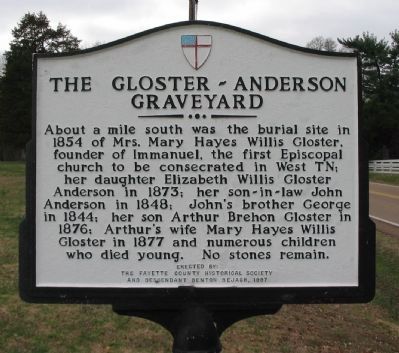
The family's Tennessee graveyard has a historic marker, though the stones do not survive.

Want to see a quilt that Elizabeth Gloster Anderson made in 1844? Sure you do! The Henry Clay Estate at Ashland has this one, a political quilt supporting Henry Clay:



Wednesday, September 23, 2009

2. Eliza Adam (1798-1817)

By alphabetical chance, the second student to write about from the Mordecai school is one that we can know a great deal about. But sadly, the reason we know so much is that she didn't live long; she didn't even outlive the school itself.

Eliza Ann Adam of Fayetteville was born in 1798. Her father was Robert Adam (1759-1801), a wealthy Scottish-born merchant, but she was very young when he died. Arriving in 1809, Eliza was one of the first Fayetteville girls at the Mordecai school, an 11-year-old who became a great favorite of the Mordecai family. Samuel Mordecai even called her "his little adopted sister." Solomon Mordecai said of her, "no one that could appreciate the value of an affectionate disposition could feel otherwise than attached."

Eliza's younger sister Margaret joined her at Warrenton in 1812, the year Eliza finished her studies there. In 1813, Eliza was sent to the North to "polish" her manners in Boston. Soon, she was engaged to John Adams Cameron (1788-1838), a UNC alumnus and wounded veteran of the War of 1812, one of the prominent North Carolina Camerons.

This engagement was the beginning of the end for Eliza. She took an overdose of laudanum, apparently in hopes of avoiding the match. But she survived the overdose and the scandal, and the marriage proceeded as planned, taking place on 13 January 1815. In 1816, Eliza Adam Cameron's daughter was born. Eliza's health was further damaged in the pregnancy (and probably by her continuing unhappiness with the marriage). She took a course of mercury and other treatments, but nothing slowed her deteriorating health. When John Cameron's business required a trip to Europe, it was decided that Eliza might benefit from a sea voyage. They arrived at Liverpool, then took another sea journey to Greenock (her father's birthplace on the coast of Scotland).  She stayed with an aunt near Ardrossan, where Eliza Ann Adam Cameron died in 1817, still a teenager. (The Cameron Family Papers from 1817 have several reports of Eliza's final days.) (Edited for clarity after an anonymous comment, 10/30/14)

Her widower, John Adams Cameron, married again the following year. In 1822 he was appointed consul to Brazil. In 1831 he continued his diplomatic career in Veracruz, Mexico. John A. Cameron was appointed to the new US District Court of Florida. Judge Cameron died by drowning when the steamship Pulaski was lost at sea in 1838.

Eliza's only child, Mary Elizabeth Cameron (1815-1845), married Dr. Halcott Pride Jones (1815-1889) in 1838, and had at least four children--the first, Eliza Adams "Lizzie" Jones (1839-1911), named for her long-dead grandmother, the Mordecai student.